

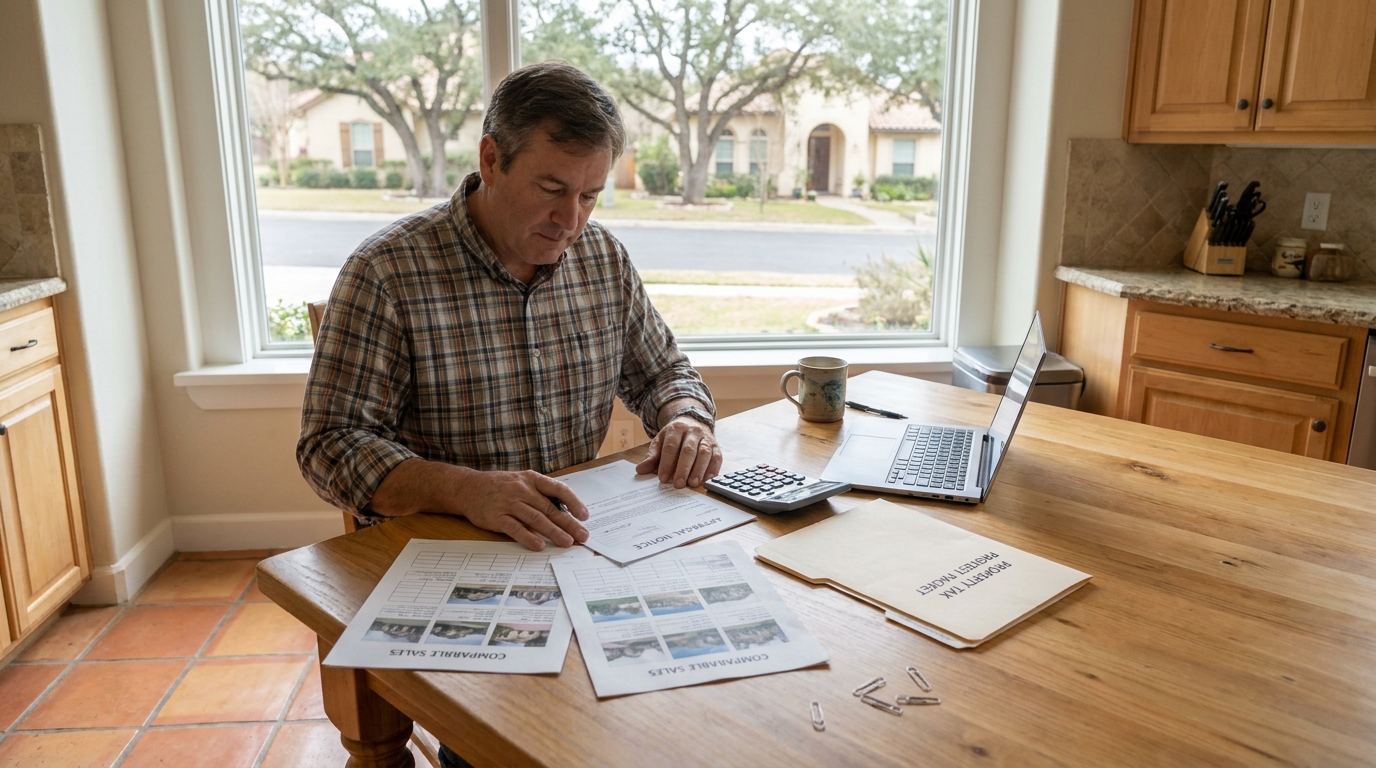
Every April, Bexar County homeowners open a notice from BCAD and feel that same mix of frustration and confusion. The number looks high. Maybe it feels way off. But then what? Most people either accept it or assume the protest process is too complicated to bother with.
We want to change that.
The protest process is more approachable than it looks, and the homeowners who get results are usually not the ones with the fanciest arguments. They are the ones who showed up organized. This guide walks you through how to build a packet that tells a clear, evidence-backed story about what your home was actually worth on January 1.
Process details below reflect the most current BCAD guidance available as of 2025. Deadlines, portal limits, and hearing procedures can change, so always confirm directly at help.bcad.org before you file.
Key Takeaways
File by May 15 or 30 days after your notice mailing, whichever is later. The deadline printed on your notice controls, so check it first.
A protest packet is a structured argument, not just a pile of documents. Here is BCAD's value, here is what it should be, and here is why.
You can protest on three grounds: incorrect property records, a market value above what your home would actually sell for, or unequal appraisal compared to similar homes nearby.
Request BCAD's evidence packet after you file. You are entitled to see what they plan to use, and reviewing it early shows you exactly where to push back.
Most protests are resolved at the informal conference, before a formal Appraisal Review Board hearing is ever needed.
Evidence for a formal ARB hearing must be exchanged in advance. Both sides share what they plan to use, which is why organization matters so much.
A lower market value does not automatically lower your tax bill. Homestead cap rules and exemptions affect your taxable value separately.
What Should Your BCAD Protest Packet Prove?
Before you grab a single document, get clear on what you are actually arguing. BCAD is not looking for frustration. They are looking for a reason to change the number, and the strongest cases are specific ones.
There are three main grounds for protesting in Bexar County, and each one calls for different evidence.
Incorrect Property Records
BCAD's value starts with their data about your home: square footage, year built, lot size, bedroom and bathroom count, construction quality, features like pools or additions. If any of that is wrong, the value sitting on top of it is also wrong.
Pull your property record from bcad.org and compare it to your survey, closing disclosure, or permit records. A home valued at 2,100 square feet that is actually 1,950 is a straightforward error, and fixing it is the first thing worth doing.
Market Value as of January 1
Texas appraisal districts value property as of January 1 each year. That date matters more than most people realize. If the market had already softened or your home had a condition issue on that date, your evidence needs to reflect that specific point in time, not what homes are listed for right now.
The Texas Comptroller's guide to property valuation is a helpful reference. The goal is showing what a willing buyer would have paid a willing seller for your specific home on January 1, nothing more, nothing less.
Unequal Appraisal Among Similar Homes
Texas law also lets you protest if your home is appraised higher than comparable properties nearby, even if the value is not necessarily above market. This is called unequal appraisal, and it is calculated using an adjusted-median comparison across similar homes in the district.
The Comptroller's guide on equity appraisal explains the math. It is a separate argument from market value and can stand on its own, especially in neighborhoods where BCAD's comparables vary widely.
How Do You Review BCAD's Evidence Packet?
Once you file your protest, you can request the evidence BCAD plans to use at a formal ARB hearing. This step is worth doing, and a lot of homeowners skip it.
According to BCAD's evidence request guidance, you submit the request in writing, and BCAD must deliver the evidence at least 14 days before your hearing. What you get back typically includes their comparable sales, property record data, and valuation notes.
Look at their comparables carefully. Are they actually similar to your home in size, age, condition, and location? Did they pull sales from a neighborhood with higher price points? Are the property characteristics they have on file even accurate? Those answers tell you exactly where your counter-argument lives.
What Belongs in Your Property Tax Protest Packet?
A good packet moves in a logical order. Each section builds on the last, and by the end, the reviewer should understand your position without needing to ask questions. Here is the structure we walk clients through.
Value Summary and Requested Value
Start with one page. It should include your account number, the grounds you are protesting on, BCAD's proposed value, your opinion of value, and three to five reasons you believe the number is too high. Keep it short. This page sets the tone for everything that follows.
Exhibit Index and Page Numbers
Label every document as an exhibit (Exhibit A, Exhibit B, and so on) and include an index page that lists each one with a brief description. It makes the packet easy to follow during a hearing and signals that you came prepared.
Property Record Error List
If BCAD's data about your home is wrong, spell it out clearly. A simple two-column list works well: what BCAD has on file versus what the correct information actually is. Attach the documentation that proves it, such as a survey, permit, or builder spec sheet.
Comparable Sales and Adjustments
This is often the most persuasive part of the whole packet. Find homes that sold near January 1, close to your property, that are similar in size, age, condition, and features, then show that those sales support a lower value. A clean grid makes the comparison easy to follow:
Address | Sale Date | Sale Price | Sq Ft | Age | Condition | Pool | Adjusted Value |
|---|---|---|---|---|---|---|---|
123 Example St | Nov 2024 | $310,000 | 1,850 | 2005 | Average | No | $310,000 |
456 Sample Ln | Dec 2024 | $298,000 | 1,780 | 2003 | Average | No | $301,000 |
In San Antonio, details like subdivision phase, school district, builder grade, and renovation level move values more than people expect. Two homes on the same street can look similar on paper and sell very differently. We regularly help past clients pull and review comparable sales during protest season, subject to MLS rules, and those details often make the difference.
Condition Photos and Captions
If your home has deferred maintenance, foundation concerns, aging systems, or anything else that affects value, photograph it. Each photo should include a caption noting the location, what the issue is, and when it was taken. The Bexar ARB Hearing Procedures identify condition photographs as relevant evidence. Clear, labeled photos are far more persuasive than a verbal description.
Repair Estimates and Reports
A contractor estimate or inspection report adds weight to your condition argument. Keep in mind that BCAD does not apply a dollar-for-dollar deduction from repair costs. The real value of an estimate is showing that a knowledgeable buyer would have factored those costs into an offer.
Purchase Documents and Appraisals
If you bought the home recently, especially near January 1, your sales contract and closing disclosure can be useful. A recent arm's-length transaction is one of the clearest signals of market value. An independent appraisal carries similar weight, particularly one commissioned close to the valuation date.
How Should You Submit Evidence to BCAD?
Getting the evidence right is only half of it. Submitting it correctly matters just as much, and the rules differ depending on your hearing format.
Online Portal Submission
After filing through BCAD's protest portal, upload evidence through the Evidence View section of your protest. Files should be PDF or JPEG. Current limits are 10 MB per file, 20 MB total, and up to 10 photos.
In-Person ARB Submission
At a formal in-person hearing, both sides exchange the evidence they plan to use. Bring physical copies you can leave with the board. Reviewing documents on a phone is generally not accepted as a substitute for printed exhibits.
Phone and Zoom ARB Submission
Remote hearings are available, but they carry an extra step. According to BCAD's remote hearing guidance, evidence submitted for a phone or Zoom hearing must include a notarized affidavit or unsworn declaration. BCAD recommends submitting at least 48 hours before the hearing.
How Should You Use the Packet at BCAD Hearings?
The packet does most of the work before you say anything. How you present it in each setting is what pulls it together.
Informal Conference Presentation
The informal conference is typically the first step, and it is where most protests get resolved. BCAD currently does not offer in-person informal meetings, so this stage generally happens by phone or through the portal.
Lead with your strongest evidence. If there is a clear property record error, start there. If your comparables are compelling, walk through them. Record any offers made in writing, including the value offered and the date. You are not required to accept, and moving to a formal hearing is always an option if the offer does not feel right.
Formal ARB Hearing Presentation
Formal hearings are typically around 15 minutes. You present first, then the appraisal district, then each side has a brief rebuttal. The homeowner chooses the order of their own presentation, so lead with what is clearest and most concrete.
Cite your exhibits by name. Close with a specific requested value and the evidence that supports it. Boards respond better to a documented, specific ask than a general objection.
If you want help pulling neighborhood sales data before your hearing, reach out through exquisitesa.com. We are happy to take a look.
Frequently Asked Questions
Can I Add Evidence After the Informal Conference?
Yes, evidence can be added for the formal ARB hearing, subject to BCAD's exchange and submission rules. Both sides are entitled to see what the other plans to use before the hearing begins.
Do Phone or Zoom ARB Hearings Require an Affidavit?
Yes. BCAD requires a notarized affidavit using Form 50-283 or a signed unsworn declaration to accompany evidence submitted for a remote hearing.
Can a Recent Purchase Price Support My Protest?
It can, particularly if the sale was arm's-length and occurred close to the January 1 valuation date. The closer the transaction, the stronger the connection to market value.
Will a Lower Market Value Always Lower My Tax Bill?
Not necessarily. If your home is under a homestead exemption and already capped, a reduced market value may not immediately affect your taxable value. The BCAD explanation of assessed versus market value is worth reading if that applies to you.
Can a Real Estate Agent Help Me Choose Comparable Sales?
Yes, though our role is helping you interpret market data, not providing a formal appraisal or tax ruling. If you want a second set of eyes on the comparables BCAD used or help identifying sales that better reflect your home's value, that is something we can help with.